

Since the beginning of time, humans have shaped legends that exist at the boundary between reality and fantasy. Mythological creatures have been witnesses and protagonists of the collective imagination, filled with symbolism, mysticism, and power. Through these beings, ancient cultures explained natural phenomena, represented deep fears, or established social norms passed down through generations.
This journey through the 15 most fascinating mythological creatures from different cultures not only aims to surprise you with legendary monsters or supernatural spirits but also to uncover the messages, values, and conflicts that each civilization left imprinted in its mythology. From serpents that encircle the world to creatures that teach how to plant, these beings are much more than folklore: they are the soul of the cultures that dreamt them.
And we won’t just limit ourselves to the international stage. Because Spain also has its own mythological bestiary, often forgotten outside its regions but just as impressive. That’s why this article is divided into two sections: first, we will explore the mythical creatures of the world, and then we’ll dive into the mythological beings of Spain, guardians of the landscape, fear, and oral traditions that still thrive today in villages, mountains, and forests.
Get ready for a journey through myth, history, and imagination, where the impossible takes form and each creature has something to say about the human soul.
Seven Mythological Creatures of Spain

Although often overshadowed by Greek or Norse myths, the mythological creatures of Spain are part of a rich, ancient folklore deeply connected with the landscape, religion, and regional identity. Every corner of the country, from the northern forests to the caves of the Mediterranean, holds legends passed down orally that have brought to life beings as terrifying as they are endearing.
In this section, we will explore the most representative Spanish mythological beings, many of them unique in Europe: Asturian goblins, guardian serpents in Cantabria, processions of souls in Galicia, enchanted beings waiting to be freed in the mountains, or giant figures that protect the Basque forests. These tales have survived since ancient times, mixing Celtic, Roman, Visigothic, and Christian roots.
These Spanish folklore beings not only fuel the imagination but also reflect the rural soul of each region, the daily fears of the past, and the spiritual connection with the land. Discovering them is also rediscovering a magical and deeply symbolic Spain.
1. Basajaun (Basque Country)
The Basajaun, meaning “Lord of the Forest” in Basque, is a protective figure of the natural world in Basque mythology. He is described as a giant, covered in hair, humanoid in appearance, and possessing great strength. He lives in the forests and takes care of the livestock and the land.
Although his appearance might seem terrifying, the Basajaun is not a monster, but rather an ancient sage. He taught humans how to cultivate crops, shoe horses, and work with iron. If shepherds show him respect, he protects their flocks. If offended, he can bring misfortune. He represents respect for nature and traditional knowledge.
2. Santa Compaña (Galicia and Asturias)
More than a single being, the Santa Compaña is a procession of lost souls that roams the rural roads at night. Led by a living person condemned to wander with them, it is said that whoever sees them must join or will be pursued by misfortune.
They are depicted in white robes, carrying lit candles, and their passing leaves the scent of burned wax. This supernatural phenomenon has strong Christian and Celtic symbolism and represents the weight of guilt and the closeness of death. The legend persists today, with many claiming to have seen them.
3. El Coco (All of Spain)
The Coco is perhaps the most popular mythological being in Spanish childhood. While it has taken many forms depending on the region, its essence is the same: an undefined figure that takes away disobedient children. It can live under the bed, in the wardrobe, or behind a door.
The legend of the Coco works as a behavioral control method, but its origin is much older, possibly stemming from rituals to drive away evil or to represent the darkness of night. It is the ultimate nighttime terror in Spanish oral tradition.
4. El Trasgu (Asturias and Cantabria)
This mischievous little being is one of the most beloved and well-known in northern Spain. The Trasgu is a domestic goblin that appears in homes where he is not respected or ignored. He wears a red hat, limps on one leg, and often carries a jar or bag. He loves making noises, hiding objects, or moving things around.
Although annoying, he is not evil. If treated with kindness, he can help with household tasks. If not, he becomes a nightmare. The Trasgu symbolizes the presence of the other world in daily life and the importance of order and hospitality.
5. La Encantada (Found in various regions)
The figure of La Encantada appears in many legends from Castilla, Aragón, Valencia, Catalonia, and Galicia. She is a beautiful woman, often associated with water or caves, who appears at special moments (such as the night of San Juan) waiting to be freed from a spell.
To break the enchantment, the hero must undergo trials, remain silent, or resist temptation. These legends are linked to pre-Christian myths of mother goddesses, nymphs, or spirits of the landscape. La Encantada symbolizes the unattainable, impossible love, or hidden wisdom.
6. El Culebre (Asturias and Cantabria)
The Culebre is a huge winged serpent, fierce in nature and a guardian of treasures or enchanted maidens. It lives in caves, rivers, or mountains and spits fire. It is linked to ancient dragons or creatures similar to those in Celtic folklore.
In some legends, the Culebre ages so much that it becomes an even more fearsome creature but can be defeated with art and cunning, not just force. It represents primal chaos and the dangers lurking outside human control.
7. El Hombre Pez de Liérganes (Cantabria)
One of the most mysterious and documented legends of the 17th century in Spain. The Hombre Pez was a young man who disappeared in the Miera River and was later captured in the bay of Cádiz, covered in scales, unable to speak, and with aquatic habits. It was said to be the same young man, transformed into a sea creature.
This myth blends historical facts, popular chronicles, and supernatural elements. It has been interpreted as a warning about the power of the sea, the loss of identity, or the influence of the unknown on rural life.
The 15 Most Fascinating Mythological Creatures from Different Cultures

Each culture has created its own universe of myths, filled with symbols, gods, and legendary creatures that embody good, evil, chaos, or wisdom. In this section, we invite you to discover the 15 most fascinating mythological creatures from different cultures around the world: beings that have transcended generations and borders, and continue to awe.
From the majestic Garuda of Hinduism to the feared Medusa of Greek mythology, passing through Nordic, Japanese, and Mesoamerican entities, each creature tells the story of its time, its people, and their beliefs. These are not merely monsters or fantastic beings: they are living symbols of what a civilization feared, desired, or could not fully comprehend.
This journey is both an exercise in awe and a lesson in cultural history. By getting to know these creatures, you will better understand how the ancients perceived their place in the world, nature, the afterlife, and their own passions.
1. Chimera – The Symbol of Impossible Chaos (Greek Mythology)
The Chimera is one of the most emblematic mythological creatures of ancient Greece, recognized for its monstrous appearance: a lion’s head, a goat’s body, and a serpent’s tail. Some versions even describe it with a second goat head protruding from its back and a dragon at the end of its tail, which reinforces its image as a representation of chaos and the unnatural.
This legendary being was born from the underworld, daughter of Typhon and Echidna, the “parents of monsters,” according to Hellenistic mythology. The Chimera instilled terror in Lycia, devouring flocks and destroying villages until Bellerophon, riding Pegasus, defeated it by thrusting a lead spear into its throat, suffocating it with its own fire.
The figure of the Chimera goes beyond the fantastic; it has served as a metaphor for the irrational, for the impossible to combine, and it has remained present in art, literature, and everyday language (the expression “chasing chimeras” shows this). Its persistence in popular culture shows how mythological beings also serve as mental symbols that condense complex ideas into memorable visual forms.
► You may be interested in: Aphrodite
2. Ammut – The Devourer of Souls (Egyptian Mythology)
Within the intricate religious system of Ancient Egypt, few creatures inspire as much respect as Ammut, the “devourer of the dead.” This mythological being was feared for its role in the judgment of the soul after death. With the body of a lion, the torso of a hippopotamus, and the head of a crocodile — the three most dangerous animals of the Nile — Ammit symbolizes unyielding justice and the final judgment.
When a person passed away, their heart was placed on a balance scale in front of Maat’s feather, the goddess of order and truth. If the heart was burdened with sin, Ammut would devour it instantly, condemning the soul to eternal oblivion. It was not a demon in the Western sense but an embodiment of justice, a divine mechanism to maintain the cosmic balance.
The figure of Ammit was not revered or worshiped but feared with reverence. She represented the worst thing that could happen after death: not punishment, but annihilation. In this sense, she differed from other mythological creatures because she was not an enemy of the gods but their executor.
This sacred monster is still studied as an example of how ancient cultures projected their values onto the afterlife. In the case of Egypt, punishment was not eternal torment, but the denial of existence itself.
3. Kitsune – The Mystical Fox with a Thousand Faces (Japanese Mythology)
Within the rich universe of Japanese folklore, few figures are as enigmatic and multifaceted as the kitsune, a fox with supernatural powers, longevity, and superior intelligence. According to tradition, the older a kitsune is, the more tails it has, and when it reaches nine, it becomes an almost divine creature.
The kitsune is deeply ambiguous: in some stories, it is a loyal protector, messenger of the goddess Inari, associated with prosperity and fertility; in others, it is a trickster capable of taking human form to deceive, seduce, or punish. It can take the form of a beautiful woman and live among humans for years before its true nature is revealed.
These legendary creatures are not just part of fantasy. The kitsune reflects key concepts in Japanese thought, such as moral ambiguity, transformation, and respect for nature. Additionally, it embodies the idea of the yōkai, spiritual or ghostly beings that exist between the visible and invisible realms.
Today, the kitsune continues to appear in manga, anime, and video games, adapted to each era but never losing its mysterious essence. Its legacy is a testament to the symbolic power that mythological beings have in the construction of cultural identity and narrative.
4. Fenrir – The Wolf of the End of the World (Norse Mythology)
Among the most feared mythical monsters by the Nordic peoples is Fenrir, a gigantic wolf, son of the trickster god Loki and the giantess Angrboda. From his birth, the gods feared him due to a prophecy: that he would be the killer of Odin during Ragnarök, the end of the world.
They tried to raise him in Asgard, but his size grew uncontrollably. To prevent disaster, the gods attempted to bind him. After breaking two chains forged with divine strength, they succeeded in binding him with Gleipnir, a magical ribbon made from impossible elements (such as the sound of a cat’s footsteps or the roots of a mountain). During the binding, Tyr, the god of honor, lost his hand, demonstrating the sacrifice required to contain chaos.
Fenrir symbolizes the inevitability of destiny and the struggle between order and destruction. Unlike other mythological beings, his evil is not gratuitous but a consequence of how he was treated. Many studies interpret him as a victim of the prophecy that he ultimately fulfills.
Today, Fenrir has been reinterpreted in popular culture as an archetype of the “misunderstood monster” and of chaos waiting for its moment to break free. His story is also a warning of how fear can become a self-fulfilling prophecy.
5. Wendigo – The Hunger that Consumes All (Algonquian Mythology)
In the legends of the Algonquian peoples of the northeastern United States, the Wendigo is a terrifying figure that represents total dehumanization and the curse of greed. It was originally human but, after resorting to cannibalism during times of famine, transformed into a creature with gaunt features, with withered skin, sunken eyes, and an insatiable hunger.
This mythological being personifies excess, the corruption of the soul, and the break with community. It not only devours human flesh but can possess others, turning them into Wendigos through selfishness, isolation, or despair. In this way, its legend also served as a moral warning.
Unlike other monsters that dwell in remote places, the Wendigo could appear within any human who crossed certain limits. In this sense, it is not merely a supernatural beast, but an allegory of the loss of humanity.
In modern times, the Wendigo has been used in literature and cinema as a symbol of disorder, addiction, or mental imbalance. Its mythology reminds us that true monsters sometimes arise from within.
6. Kraken – The Terror of the Northern Seas (Scandinavian Mythology)
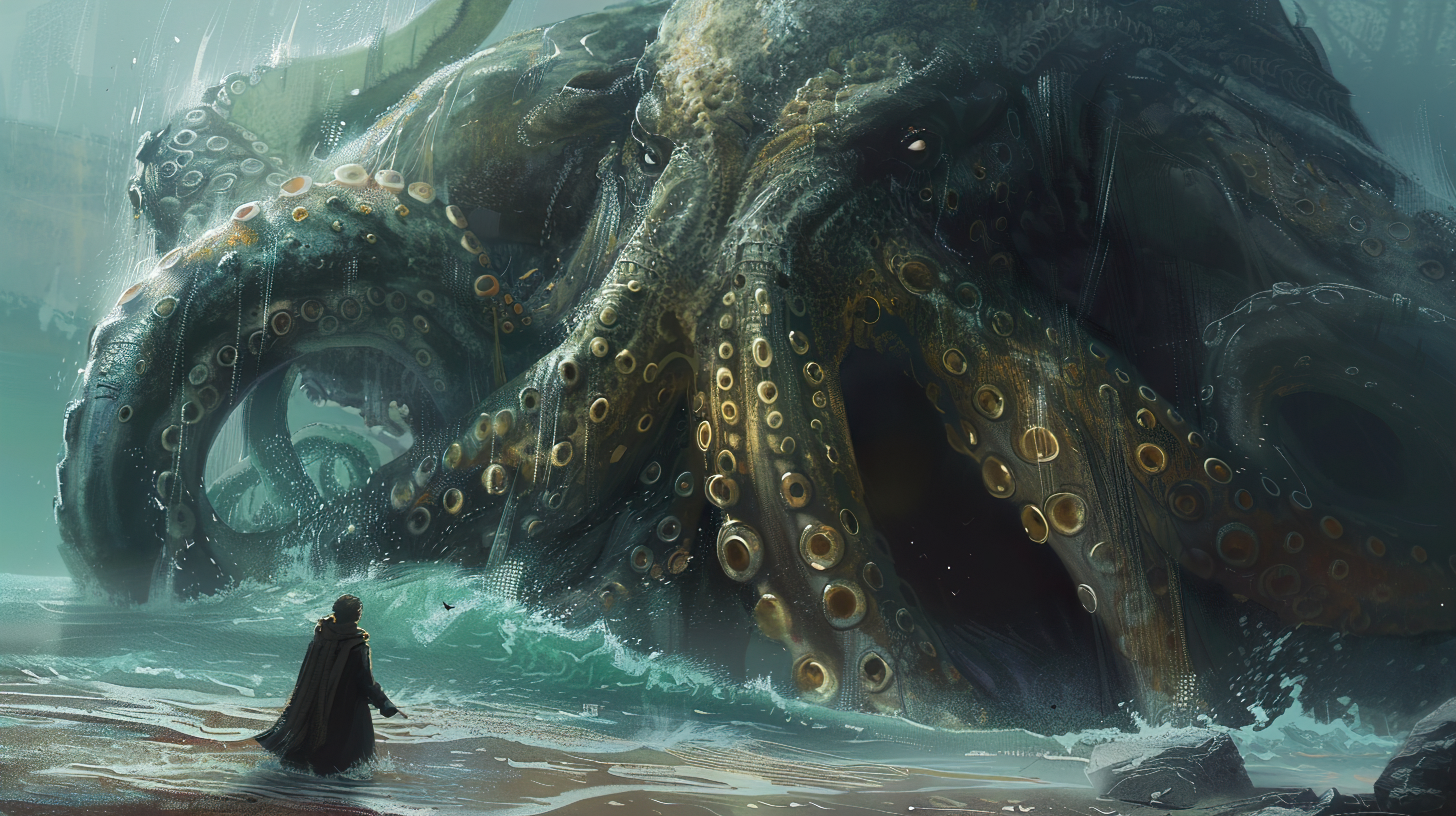
The Kraken is one of the most imposing and terrifying creatures in Scandinavian tradition. Described as a gigantic sea monster, resembling a colossal squid or octopus, it was capable of creating whirlpools as it emerged from the depths, destroying ships with its enormous tentacles. To Nordic sailors, simply spotting this beast was synonymous with imminent death.
The first written references to the Kraken appear in Norwegian tales from the 13th century and later in Icelandic chronicles. However, it was during the 17th and 18th centuries that the legend took its modern form thanks to records from explorers and naturalists, who mixed mythology with exaggerated observations of real giant squids.
The Kraken embodies the ancient fear of the ocean: an unfathomable abyss, full of hidden and uncontrollable dangers. At a time when the seas were trade routes, battlefields, and wild territories, these legendary beasts helped explain disappearances, shipwrecks, and unknown marine phenomena.
Today, its image has transcended the borders of Scandinavian mythology. The Kraken has been adopted in fantasy literature, cinema, and video games as a symbol of chaos unleashed from the depths. In marketing, it even represents strength and hidden power, as seen in beverages and sports teams. But beyond its modern use, it remains a symbol of terror that waits in the unknown.
7. Nian – The Monster that Originated Chinese New Year (Chinese Mythology)
In the vast Chinese oral tradition, the Nian is a legendary creature that emerges every year to sow panic in villages and devour crops, animals, and children. Its name, which also means “year” in Chinese, is directly linked to the origin of the Lunar New Year celebrations, one of the most important in the Chinese calendar.
The Nian lived deep in the sea or in the mountains, and its appearance coincided with the last day of the year. Described as a mythical beast with the body of an ox and the head of a lion, its greatest weakness was the color red, fire, and loud noises. As a result, villagers began decorating their homes with red lanterns, lighting firecrackers, and hanging strips of paper to drive it away. Thus, the festive tradition was born.
This story not only has mythological value but also a pedagogical function: it teaches the importance of community, bravery, and celebration as tools to overcome fear. The Nian is not a naturally evil monster but a cyclical force that can be contained through collective rituals.
Unlike other mythological creatures, the Nian is not an object of worship or permanent fear but a figure that was culturally domesticated. Its story is a demonstration of how myth can evolve into tradition and ritualize fear to transform it into hope and joy.
Today, during Chinese New Year, the spirit of the Nian still lives in every firework, every lion dance, and every red banner that adorns the cities, reminding us that even the most terrifying threats can be overcome with unity and wisdom.
8. Tlaltecuhtli – The Monstrous Goddess of the Earth (Aztec Mythology)
In the Aztec worldview, the universe was created through an act of sacred violence, and the central creature in this process was Tlaltecuhtli, a monstrous deity that represents the earth itself. Her name means “lord/lady of the earth,” and she is described as an androgynous figure with a reptilian body, claws, and a voracious mouth at each joint.
According to Nahua myths, the gods Quetzalcoatl and Tezcatlipoca descended from the sky to fight against Tlaltecuhtli, who roared and devoured everything in her path. After defeating her, they tore her apart and created the world from her body: her hair became trees and flowers, her eyes became springs, and her skin became mountains and valleys. However, her essence remained alive and demanded human sacrifices to maintain the cosmic order.
Unlike other mythological beings, Tlaltecuhtli was not an absolute enemy but an essential component of the balance between life and death. Her face appears in temples, codices, and sculptures with a fierce expression and a knife-like tongue, symbolizing the power of the earth as both a giver and devourer of life.
Her monstrous and divine duality reflects the complex worldview of the Aztecs: existence as a constant cycle of creation and destruction, sustained by sacrifice. For them, paying tribute to Tlaltecuhtli was a way of keeping the life cycle functioning.
Today, archaeological and anthropological studies continue to unravel her deep meaning. More than just a monstrous creature, Tlaltecuhtli is a cosmic symbol of eternal return and the interdependence between humanity and the earth.
9. Garuda – The Enemy of Snakes (Hindu Mythology)
Within the Hindu and Buddhist pantheon, Garuda stands as a majestic figure: half man, half eagle, with golden wings that cover the sun when spread. He is the official mount of the god Vishnu, and his role as a mythological creature goes beyond the decorative; he represents the victory of knowledge over darkness, of good over evil.
The story of Garuda begins as a test of strength, wisdom, and loyalty. To free his mother from the slavery imposed by the nagas (sacred snakes), Garuda embarks on an odyssey where he faces divine challenges, defeats gods, and ultimately obtains the nectar of immortality. However, he gives it to his enemies as an honor, without drinking it, thus earning the respect of Vishnu, who makes him his celestial vehicle.
Garuda not only appears in sacred texts like the Mahabharata and the Puranas, but is also a national symbol in countries such as Thailand and Indonesia, where his figure represents sovereignty, courage, and vigilance. In architecture and religious art, he is commonly seen protecting temples and devouring nagas, symbolizing his protective role.
This mythical creature represents spiritual elevation, detachment from ego, and the flight toward supreme truth. In the Buddhist context, he also symbolizes the struggle against the poison of desire and ignorance.
Garuda is not just a fantastic animal: he is an emblem of virtue and power, whose image remains alive in contemporary iconography and the collective imagination of South Asia.
10. Tikbalang – The Mischievous Spirit of the Roads (Filipino Mythology)
From the tropical jungles of the Philippines emerges the enigmatic Tikbalang, a creature with the head of a horse, humanoid body, and inverted legs. This mythological being is known as a trickster who roams the roads, playing with unsuspecting travelers and making them lose their way in endless loops.
The legend of the Tikbalang dates back to pre-colonial times, although it was influenced by Hispanic elements. It is said to inhabit large trees like the balete, and it can become invisible. Although considered dangerous, it can also be tamed if one manages to steal one of its magical hairs. Once this is done, it becomes a faithful servant.
This mythological being embodies the fear of the unknown and untrodden paths. It also serves as a warning to respect nature and not venture into it without permission. Many Filipino farmers still follow rituals to ask for permission before cutting a tree, out of fear of disturbing a Tikbalang.
Aside from its fearsome appearance, the Tikbalang reflects the belief in guardian spirits who protect natural territories. It is a perfect example of how legendary beings represent anthropomorphized forces of nature.
► You might be interested in: The Trojan Horse
11. Jörmundgander – The World Serpent (Norse Mythology)
In the Norse pantheon, Jörmundgander is one of the most imposing and symbolic figures. Known as the “world serpent,” she is the daughter of Loki and the giantess Angrboda, sister to Fenrir and Hel. According to the mythology, Odin threw Jörmundgander into the ocean surrounding Midgard (the world of humans), and there she grew so much that she ended up biting her own tail, encircling the entire world.
This mythological creature symbolizes the eternal cycle: the serpent that bites its tail is a clear representation of the ouroboros, an ancient concept of eternity, self-regeneration, and endless cycles. But she is also an agent of fate. During Ragnarök, the battle of the end of time, she will be released and fight with Thor, who will manage to kill her but will die himself after walking nine poisoned steps.
Jörmundgander embodies contained chaos: a latent threat that marks the fragility of the divine order. Her connection to the ocean and to universal cycles reflects the Viking worldview, which saw the world as a constant tension between balance and catastrophe.
Additionally, her confrontation with Thor is not just a physical duel, but a symbol of the end of the age of the gods. This mythological creature is one of the most profound in terms of symbolic weight: showing how destruction is inevitable but also necessary for a new beginning.
Her legacy has crossed the borders of myth, appearing in multiple contemporary works, from video games like God of War to fantasy epic movies and novels, maintaining her imposing and cyclical presence as a reminder of the inevitable.
12. Púca – The Shapeshifter of Celtic Folklore (Irish Mythology)
The Púca, also spelled pooka or pwca, is a mythological creature from Celtic folklore that can shapeshift at will. It is an elusive and ambiguous entity, capable of appearing as a black horse with glowing eyes, a ghostly dog, a wild cat, or even as a human figure with animal features. Its nature is mischievous and sometimes dangerous, though it can also show benevolent gestures.
In many tales, the Púca appears at night to scare travelers, make them lose their way, or even mount them and take them on a wild ride through the countryside before leaving them safe, though confused. In other versions, it offers wise advice, helps farmers, or even protects homes.
This ambiguity makes it a fascinating figure within the repertoire of mythological beings: it is neither a classic monster nor a protective spirit, but a reflection of the whimsical and wild character of Celtic nature. The tradition of offering it food during Samhain — the Celtic harvest festival — was maintained to avoid its wrath.
The Púca has also been linked to specific places in the Irish landscape, such as hills, rivers, or ruins, showing how these creatures are connected to the geographical and spiritual environment. It is a manifestation of the ancestral respect for the land and its invisible forces.
Today, its influence remains in stories, festivals, and modern adaptations. Its shapeshifting nature makes it a symbol of mystery, unpredictability, and that which escapes human control, yet is part of the natural order.
13. Banshee – The Wail of Death (Irish Mythology)
The Banshee is a figure deeply rooted in Irish folklore and one of the most chilling within the world of mythological creatures. It is not a monster or a goddess, but an ancestral spirit who announces the imminent death of a family member with her cry, a sharp and penetrating wail that chills the blood.
The word “banshee” comes from the Gaelic bean sídhe, meaning “woman of the mound” or “woman of the other world.” She is described as a female figure dressed in white or gray, with long flowing hair, often covering her face while crying. In other versions, she appears as an old woman with a withered face or a young woman of extraordinary beauty.
Although her appearance may seem terrifying, the banshee does not physically harm anyone. Her wail is a message from the beyond. It was said that only certain noble Celtic families were “accompanied” by a banshee, which gave her an aristocratic and even protective air.
This mythological being is full of symbolism: it represents the connection between the living and the dead, respect for ancestors, and the acceptance of mortality as part of the natural cycle. Her cry is not just a forewarning but also an anticipated mourning.
Today, the banshee has been reinterpreted in cinema, literature, and video games as a spectral and emotional figure. Her legacy continues to evoke that unique blend of beauty, fear, and sadness that defines many Celtic mythological beings.
14. Huitzilopochtli – The Hummingbird of War (Aztec Mythology)
Although in the modern world gods are often distinguished from mythological creatures, in Aztec culture, this distinction was not as clear. Huitzilopochtli, the sun and war god, is depicted as an armed hummingbird, a hybrid creature that combines the ethereal with the warlike. His figure is one of the most powerful and complex in the Aztec pantheon.
His name means “left-handed hummingbird” or “hummingbird of the south,” and he was attributed with leading the Mexicans in their migration from Aztlan to the founding of Tenochtitlan. During this journey, Huitzilopochtli spoke through the priests, guiding the people to the promised land, where the Aztec empire would rise.
Unlike the delicate hummingbird we know today, the mythological Huitzilopochtli was a warrior being, nourished by human sacrifice, essential for maintaining the movement of the sun. His symbolism embodies a deep connection between war, religion, blood, and fertility.
In artistic representations, he is covered in hummingbird feathers, carrying weapons and surrounded by solar flames. More than just a distant god, he was a constant presence in the lives of the Aztecs, whom they invoked before going to war, dedicating temples, rituals, and offerings to him.
This divine-hybrid creature is an example of how Aztec mythology used animals to represent abstract concepts such as strength, spiritual guidance, and the permanence of the cosmic order. Huitzilopochtli was not only a god, but also a mythological creature alive, omnipresent, capable of founding and sustaining an empire with his mere will.
► You may be interested in: Olympus
15. Medusa – The Gaze that Turns to Stone (Greek Mythology)
Among all the Greek mythological creatures, few have had as lasting an impact as Medusa. One of the three Gorgons, Medusa was the only mortal, and her story is one of the most complex in classical mythology. With snakes for hair and a gaze capable of turning anyone to stone, Medusa embodies terror, beauty, and divine vengeance.
According to the myth, Medusa was originally a beautiful priestess of Athena’s temple. She was raped by Poseidon inside the sanctuary, and Athena, instead of punishing the god, condemned Medusa to become a monster as punishment for profaning her temple. This version of the myth has been subject to multiple reinterpretations, especially with a feminist perspective.
Medusa’s death at the hands of Perseus is one of the most well-known heroic tales. Perseus used a shield as a mirror to avoid looking directly at her and cut off her head, from which Pegasus and Chrysaor were born. Medusa’s head remained so powerful that it was used by Athena in her shield, the Aegis, as a symbol of protection and terror.
Medusa represents multiple archetypes: victim and executioner, beauty and monstrosity, mortal and eternal symbol. She is an example of how myths evolve with societies, and how mythological beings reflect our own contradictions.
► You may be interested in:
The Legend of Echo and Narcissus | Orpheus and Eurydice | Dionysus Bacchus
The Judgment of Paris | The Myth of Oedipus | The 9 Muses of Greek Mythology | King Midas